



The Human Resource (HR) Manager is primarily responsible for developing policies related to employee recruitment, development, motivation and retention, and in supporting Line Managers to implement these policies. For example, the HR Manager establishes appropriate compensation and benefits practices, ensures that strategies that enhance employee commitment are in place and that, when their time comes, they leave with dignity and honor.
Our focus, in this blog, lies in getting us to think critically about two areas central to Employee motivation and commitment, both of which are often insufficiently addressed. The first of these is the gap between home and the workplace; while the often contentious relationship between Managers and their Employees is the second. Both these areas play an extremely crucial role in ensuring Employees are highly motivated and committed to the organization.
The gap between home and the workplace
Let’s place attention on the gap between home and the workplace. Every day Employees leave home to go to workplaces. Unfortunately, for most Employees going to their workplaces is simply an activity that is essential but is inconvenient. They go to work, not because they seek and gain pleasure in being present at the workplace but because they must work in order to earn an income with which to pay their bills.
In these circumstances, Employees welcome weekends and holidays, as they dread every Monday and are happy for any event that interrupts the daily work routine. For them, the workplace isn’t a place from which they obtain joy but is instead one that they seek to avoid. This situation, generally the norm in most organizations, is perhaps the single biggest obstacle to Employee motivation and commitment.
Line Managers and Employees: competing interests
The second issue concerns the relationship between Line Managers and Employees. Line Managers, primarily, establish and enforce Employee key performance indicators. Line Managers are often responsible for achieving operational targets set by Senior Management, which can involve reducing costs, including maintaining or cutting employee compensation and benefits. Employees, on the other hand, seek to maximize the rewards, compensation, and benefits they receive from the organization.
Consequently, the objectives of Line Managers and the aspirations of Employees are often in conflict. These differing interests must be carefully managed in order to maintain a productive and harmonious working relationship between Line Managers and Employees.
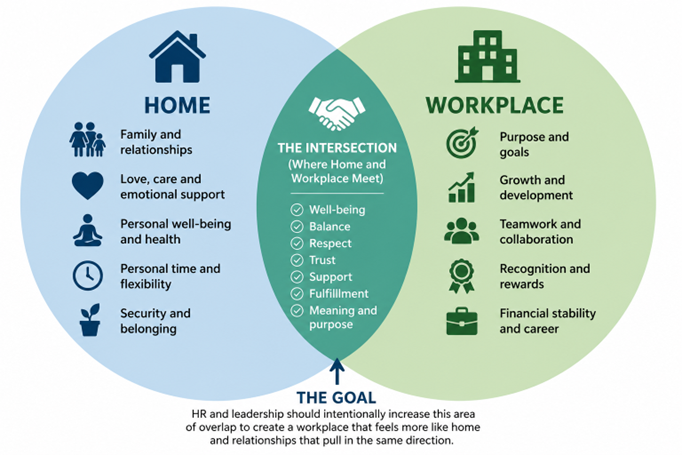
The Venn Diagram below illustrates well the gap between home and workplace and the aspirations of Line Managers vs the aspirations of Employees.
Bridging the gap: the HR Manager’s mandate
The HR Manager must establish strategies and foster practices that bridge the gap between home and the workplace and ensure that Line Managers and their Employees are pulling in the same direction towards achieving organizational goals. The HR Manager must strive to ensure that employees experience in the workplace a sense of family, personal wellbeing, love, care, emotional support, security and belonging in the same way that Employees might experience these in their home environment. The HR Manager must strive to build strategies and practices that achieve this outcome firmly into all the organization’s cultures, norms and everyday practices.
Organizations that intentionally bridge the gap between home and the workplace and cultivate healthy, trusting relationships between Line Managers and Employees are more likely to enjoy higher levels of engagement, innovation, commitment, productivity, and long-term success.
However, creating this alignment does not happen by accident. It requires deliberate leadership, thoughtful HR policies, supportive management practices, and an organizational culture that values people as much as performance.
Coming next: Look out for our next blog in which we explore creative and practical everyday strategies and practices that organizations and Line Managers can adopt to foster cultures that strengthen Manager–Employee relationships, and create workplaces where people genuinely strive to contribute their very best.